
Source: People’s Daily Online Yunnan Channel
From ridge guardian beasts to trending souvenir gifts — Yunnan Wamao integrates seamlessly into contemporary daily life
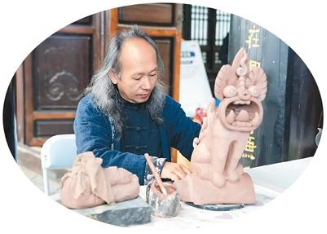
Su Longxiang handcrafts Wamao.
Photo courtesy of Yunnan Provincial Department of Culture and Tourism
When morning mist lifts and sunlight spills over old courtyard roof ridges, a plain clay guardian sculpture perches atop the tiles. These sculptures are no ordinary ornaments. Perched on roof ridges for decades, Wamao stand watch to shield families and bring peace to every household.
Exclusive to traditional Yunnan dwellings, Wamao, literally “tile cats,” are modelled after tigers, fired from clay or carved out of stone. Customarily placed at the centre of roof ridges, they carry auspicious symbolism to ward off misfortune and attract blessings.
In recent years, inheritors of Wamao craftsmanship have refreshed traditional designs to fit modern aesthetics. A diverse range of cultural and creative Wamao pieces have become wildly popular travel souvenirs, breathing new life into the inheritance of local folk culture.
Guardians Perched on Roof Ridges
Step into a Yikeyin (One-Seal courtyard, compact enclosed architecture unique to central Yunnan) courtyard in Longquan Ancient Town, Kunming. A fierce, imposing Wamao overlooks the main gate. This space belongs to the Wamao Museum within the Longquan Ancient Town Museum Cluster in Panlong District, housing Wamao specimens collected from all across Yunnan.
“Placing Wamao at the centre of roof ridges is an age-old folk custom across rural Yunnan. Also known as tile tigers, they embody people’s wishes for household protection and good fortune,” said Hong Haibo, curator of the Wamao Museum. “Wamao draw their imagery from tigers, which can be seen from the Chinese character ‘Wang’ (king, a three-stroke beast symbol) carved or painted on many specimens’ foreheads. By setting Wamao on roof ridges, eaves and gate tiles, people place a symbolic tiger high above to stand guard over their homes.”
Wamao craftsmanship prevails across Kunming, Lijiang, Dali, Yuxi, Qujing, Chuxiong, Wenshan and other Yunnan regions, crafted from locally sourced clay or stone. Hong Haibo explained that early artisans sold handmade Wamao at rural market fairs, resulting in highly localized styles shaped by local raw materials and folk beliefs. Dali Wamao feature exaggerated forms with horns between their ears, roaring skyward to project mighty solemnity. Wenshan’s stone-carved Wamao carry subdued facial lines yet vivid expressive charm, with simpler, minimalist silhouettes.
There exists no fixed standard for Wamao shapes or production techniques. The Wamao Museum’s collection boasts nearly 400 pieces. Some bear neat, square teeth for a mild, honest vibe; some are sculpted with fish-scale textures or twin horns; some are fitted with hand-carved wings; others take abstract unidentifiable forms that spark boundless imagination among visitors.
Different styles carry unique folk names: Ridge-Taming Tiger, Auspicious Tiger, Stone Cat, the mythical Four-Dissimilar Creature, and more. “Every Wamao holds its own unique spirit and freehand artistic beauty — no two are identical,” Hong Haibo commented.
The boundless creative spirit embodied in Yunnan’s Wamao opens vast space for craft inheritance and innovative design. In 2022, Kunming Wamao craftsmanship was inscribed on the Yunnan Provincial Representative List of Intangible Cultural Heritage Items. To date, more than 20 provincial-level inheritors specialize in Wamao craft across the province.
Heritage Forged by Skilled Hands
Fifty-one-year-old Su Longxiang, a fourth-generation clay and dough sculpture artisan with over 30 years of Wamao-making experience, is affectionately nicknamed “Clay Man Su” by locals in Xizhou Town, Dali. His Wamao courtyard is filled with vintage clay Wamao pieces collected by his ancestors from all regions.
“Early Wamao featured simple outlines. My father added intricate decorative patterns to elevate their artistic appeal,” Su Longxiang told reporters. Over decades of creation, he has crafted hundreds of Wamao designs, ranging from miniature versions merely 2 to 3 centimetres tall to giant sculptures standing nearly four metres high.
In more than 30 years of practice, Su has independently finished nearly 23,000 artworks, developed over 200 types of Wamao cultural merchandise including necklaces, rings, fridge magnets and tea sets, and trained more than 200 apprentices. He has compiled extensive written records of Wamao folklore, such as the tale of the grateful Wamao and full traditional rituals for installing Wamao on roofs, driven by a single goal: to pass down this ancient craft for generations.
In a bright Kunming studio, a large workbench is scattered with sculpting tools. Zhang Hang, a post-90s intangible cultural heritage inheritor, stares intently at a tiny unfinished Wamao. A few swift brushstrokes bring its vivid eyes to life, instantly endowing the sculpture with lively spirit.
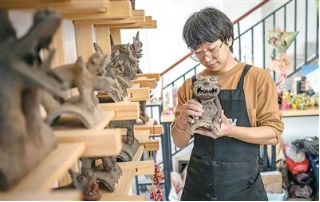
Zhang Hang sorts Wamao exhibits inside his Xinfang Wamao Museum.
Photo by Wang Guansen, Xinhua News Agency
Zhang majored in design during university, and Wamao became the theme of his graduation thesis. He first encountered the craft in a 2012 lecture and was immediately captivated by its unique “ugly-cute” aesthetic, launching in-depth artistic research from a craft design perspective. Upon graduation, he resolved to build a career around Wamao and apprenticed under Luo Aijun, a provincial-level Wamao craft inheritor.
At the start of his training, even with comprehensive fine art training and trials of diverse raw materials, Zhang could not capture the authentic spiritual charm of vintage Wamao. Frustrated, he consulted his master, who advised him to study genuine antique Wamao firsthand.
To truly grasp the essence of the craft, Zhang wandered Kunming’s old neighbourhoods, demolition sites and ancient villages across Yunnan to collect physical Wamao relics and photos. Gradually, he understood how raw materials, techniques and silhouettes shape each sculpture’s unique aura. “Chenggong’s Jar-Style Wamao are shaped from clay using pottery jar techniques, boasting symmetrical, delicate lines. Hand-kneaded Dali Wamao carry exaggerated, raw rustic outlines,” Zhang explained.
During field research, Zhang noticed traditional tiled courtyards were disappearing amid urban renewal, and rooftop niches for traditional Wamao are vanishing. In 2021, he founded Xinfang Wamao Museum to preserve and display collected antique Wamao, while drawing creative inspiration from countless varied traditional pieces.
Miniature handmade Wamao line his studio: the upright Xiahu Tiger with long limbs and head held high; the Shouhu Guardian Tiger crouching low with a raised tail; the Yinji series blending tile bases, hammer textures and ancient mortise-and-tenon joinery (interlocking wooden joint technique of ancient Chinese architecture).
“To pass Yunnan Wamao down through generations, we must innovate its craftsmanship, silhouettes and functional forms based on thorough understanding of tradition, and build Wamao into a distinctive cultural IP, unlocking greater value and innovative development for intangible cultural heritage,” Zhang Hang stated.
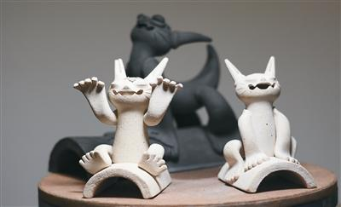
Zhang Hang’s handmade Wamao artworks
Photo courtesy of Zhang Hang
Blessings You Can Take With You
“It’s so adorable! I’ll get one for my daughter — she’ll love it!” “This Wamao incense holder looks exquisite displayed inside my study; it feels like bringing Yunnan’s misty mountains home.” During the 2025 Intangible Cultural Heritage Brand Promotion Week held in Dali, groups of tourists browse diverse Wamao cultural merchandise at exhibition stalls.
In recent years, Yunnan authorities have stepped up protection and inheritance of Wamao craftsmanship, certifying a cohort of official intangible cultural heritage inheritors. Meanwhile, growing diversified tourist demand for cultural souvenirs has integrated Wamao deeply into cultural tourism, spawning countless innovative cultural spin-offs.
Xiong Yuanyuan, a fine art and sculpture graduate, self-taught Wamao sculpting after university and launched her own cultural creative brand. She innovatively combines hand painting with clay Wamao, and her wild edible fungi-themed Wamao series quickly went viral at craft fairs and social media platforms.
“Wild edible fungi are an iconic regional symbol of Yunnan. By weaving local regional elements into Wamao designs, I make these sculptures cuter, more vivid and more representative of Yunnan’s culture. Previously, tourists would only buy flower cakes (rose-filled pastries, classic Yunnan souvenir snacks) and Pu’er tea (fermented aged tea native to Yunnan) as souvenirs; now young visitors increasingly choose Wamao crafts,” Xiong Yuanyuan said.
The cultural and creative zone of Jiangzhiji Folk Art Centre in Xizhou Town features an entire wall lined with ceramic Wamao goods: mini ornaments, coffee mugs and incense holders. Wamao hanging ornaments infused with Dali Bai tie-dye (traditional indigo tie-dye craft of the Bai ethnic minority) and blessing fridge magnets also enjoy huge popularity among young travellers.
“These pieces are creative and easy to carry. I bring them home hoping the Wamao will guard my daily life,” said Ms Wang, a tourist from Jiangxi Province.
Wamao Museum’s cultural merchandise sales have maintained robust year-on-year growth: from over 1,000 pieces in 2023 to more than 10,000 in 2024, and over 20,000 so far this year. Product varieties have expanded from an initial 20 to over 160. “Versatile creative Wamao merchandise has become a popular cultural icon among young consumers,” Hong Haibo said.
More Than Shopping: Hands-On Craft Experience
The antique Yikeyin courtyard housing the Wamao Museum functions as both an exhibition hall and a workshop for Wamao-making lessons. Primary school students from Panlong District visit regularly to knead clay and craft their exclusive Wamao under the guidance of intangible cultural heritage inheritors. “Each handmade Wamao is unique, and the sculpting process cultivates children’s imagination and creative thinking,” Hong Haibo noted.
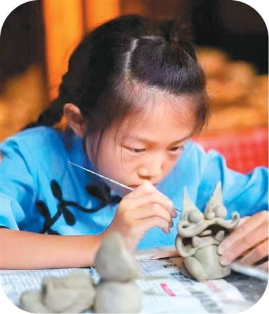
Primary school students learn to craft Wamao at the Wamao Museum
Photo courtesy of Wamao Museum
Zhang Hang is delighted every time visitors finish their unique handmade Wamao in his studio, and he takes photos to record their creations. “No finished craft purchase can replicate the sense of fulfilment from hand-sculpting your own piece. I hope people can embrace the craft’s core philosophy of staying true to nature and simplicity while creating, and experience the unique charm of Yunnan’s intangible cultural heritage,” Zhang said.
Many local primary schools have added Wamao sculpting to aesthetic education curricula. Zhang regularly visits campuses to tell children the full story of Wamao’s origins and evolution. The eager gazes of young students fuel his passion for heritage inheritance.
From the foot of Jade Dragon Snow Mountain to the shores of Erhai Lake, from classrooms and museums to cultural creative expos, these guardian beast sculptures carry heartfelt blessings, stepping down ancient roof ridges and fully integrating into modern daily life — unlocking brand-new possibilities for traditional folk culture to thrive alongside contemporary trends.