

Since mid-August, Season 3 of the short documentary series Beautiful Yunnan has gone fully online. Produced by the Yunnan Provincial Local Records Compilation Committee Office, the series has rolled out 69 brand-new episodes this year, building on the hit 31-episode run back in 2022. The series is divided into ten thematic sections: “World Heritage,” “Yunnan’s Nine Great Plateau Lakes,” “Ethnic Minorities Unique to Yunnan,” “Famous Names of Yunnan,” “Treasures of Yunnan,” “Flagship Species of Yunnan,” “Intangible Cultural Heritage of Yunnan,” “Yunnan History,” “Yunnan Mountains,” and “River Sources.” Together, they weave a vivid tapestry of Yunnan’s myriad landscapes and cultures, granting audiences a window into the province’s unparalleled natural and cultural charm. Stay tuned!
Today, join us as we explore The Watchman on the Rooftop – Yunnan Treasures: Wamao (Tile Cats).
For centuries, the wamao, an exclusive ridge guardian totem unique to China, has stood watch atop Yunnan’s rooftops. As a distinctive architectural ornament found in traditional Yunnanese dwellings, it is typically placed on the ridge above the main gate, under the eaves, or on the roof itself, serving as both a house-protecting talisman and a decorative architectural ornament.
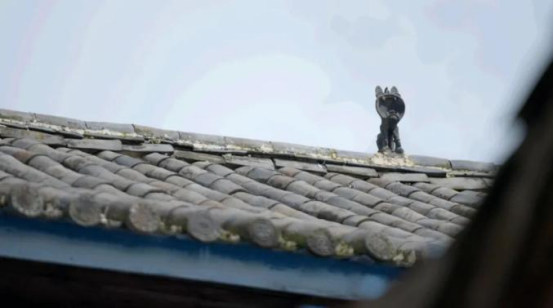
Wamao perched on a roof ridge
01 The Origin of the Wamao Image
Despite its name, which literally means “tile cat,” the wamao embodies the spirit of a tiger in the form of a cat. In Chinese folk tradition, the tiger – large, powerful, and fearsome – is revered as the “king of beasts.” Tigers were widely believed to devour malicious spirits, so the wamao perfectly embodies the core charm of “feline silhouette, tiger ferocity.”
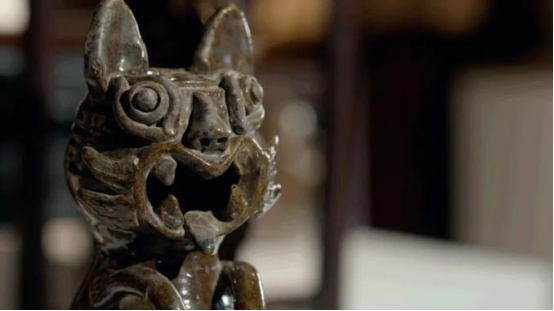
Distinctive wamao shapes
Moreover, since ancient times, Chinese folklore has maintained that “tigers can eat ghosts.” Influenced by customs and beliefs, the tiger has often been regarded as a divine beast or a guardian spirit among the common people. Many households would hang New Year paintings or scrolls bearing tiger images in their main halls to ward off evil and bring good fortune – popular motifs include “Fierce Tiger Descending the Mountain,” “Auspicious Tiger at Dragon Boat Festival,” and “Guardian Tiger Protecting the Home.” These evil-repelling guardian figures evolved into countless regional and chronological variants, and Yunnan’s wamao descended straight from this fierce tiger totem. That is why it is also commonly referred to as “divine cat,” “ridge-taming (or auspicious) tiger,” “mountain-subduing tiger,” or “auspicious ridge tiger” in folk parlance.
02 The Stylistic Features of Wamao
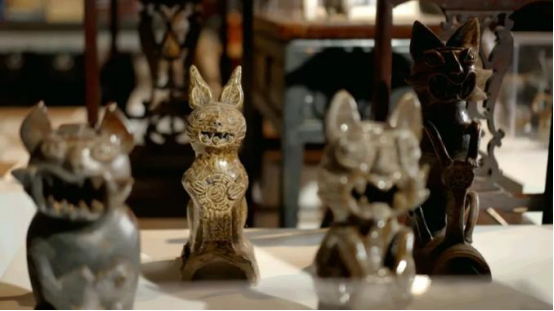
Across different areas of Yunnan, the wamao varies considerably in shape, materials, and whether it is glazed.
In Chenggong District, two main types exist: the Yi style wamao and the Han style wamao. The Yi style is typically hand moulded from unglazed yellow pottery clay. Its most prominent feature is a diamond shaped Bagua (Eight Trigrams: ancient Chinese divination symbol representing balance and home protection) plaque on the chest. It boasts thick, tiger-like sturdy limbs, planted steadily atop roof tiles. The character “王” (king) is painted in red lacquer on its forehead. Its ears stand erect, with erect ears crafted to catch sounds from all directions, while its large, bulging eyes gleam with intensity, glaring ahead. Its gaping mouth bares sharp fangs and a vivid scarlet tongue, as if ready to swallow all malevolence; the sculpture radiates awe-inspiring solemnity and innate protective power. It is believed that such a wamao can exert a deterrent influence in all directions.
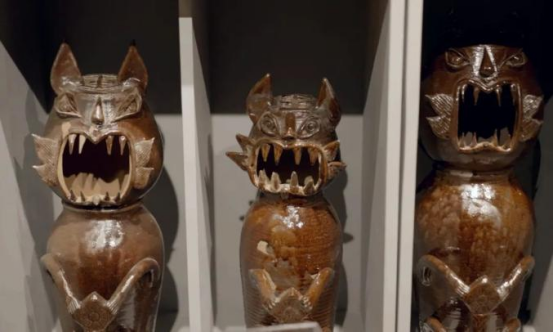
Yi style wamao from Chenggong
The Han style black glazed wamao in Chenggong may have a cylindrical or jar shaped body. Its forelegs stand straight, its tail curls upward and backward, and it also bears the Bagua emblem on its chest. Its ears are pointed, its eyes large and protruding, and its nose is an inverted triangle pressed flat against the face. Whiskers are attached to the left and right cheeks, and the mouth is wide open with prominent teeth.
The Dali area is home mainly to the Bai ethnic minority, and its local wamao is defined by an extraordinarily large integrated hollow mouth. Unlike the three dimensional round headed style of Kunming, its head takes on a flatter, disc-like concave silhouette, a feature that has become its signature hallmark. Among these, the Heqing wamao is especially unique, with its gaping mouth even larger than its body.
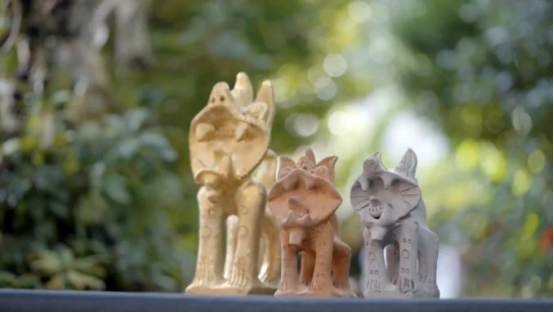
Heqing wamao
The wamao in the Lijiang area closely resembles that of Dali, but the Yongsheng variant stands out. Also nicknamed “ridge-taming tiger”, “mountain-subduing tiger” and the mythical “Four-Dissimilar Creature” (a chimera matching no single earthly creature), it measures roughly the size of an ordinary house cat. Its mouth is wide open, its eyes and postures vary, the character “王” is carved on its forehead, and its tail curves upward – all crafted from unglazed grey pottery.
03 The Cultural Significance of Wamao
In the past, these guardian beasts were usually positioned on the roof ridge, integrated with the roofing tiles, and thus called “ridge beasts” (jishou). Their placement was carefully chosen according to the homeowner’s wishes and prayers. For example, a wamao placed at the very centre of the main hall’s ridge was known as a “ridge cat” (jimao), a Chinese pun: the pronunciation ji means both “roof ridge” and “auspicious blessing”, to symbolise good fortune. A wamao installed at the centre of the gate ridge was called a “blessing basket” (fulou) or “gate guarding tiger.”
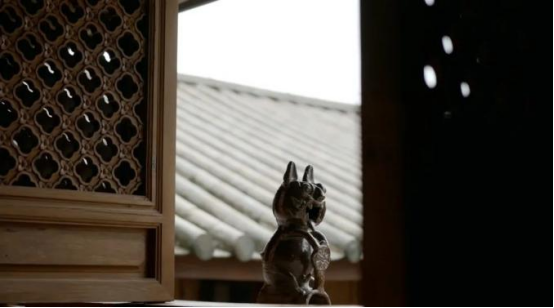
Different sculptural forms carry distinct symbolic meanings. Some wamao adopt exaggerated, striking shapes: they may stand bipedally, clutching a Bagua emblem in their forepaws, or rest on four paws roaring toward the sky, baring sharp fangs, with bulging or narrowed eyes, ferocious and rugged in appearance. In folk belief, such images are imbued with the power to guard the house and repel evil.
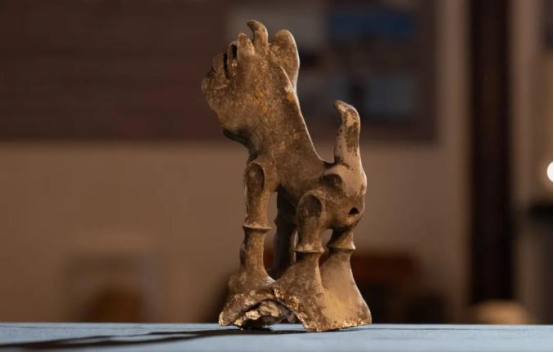
Another variant features a hollow tunnel running from head to tail, symbolizing a local Yunnan dialect proverb: “It swallows iron, yet stores gold” — signifying that hardship turns into abundant wealth within the household.
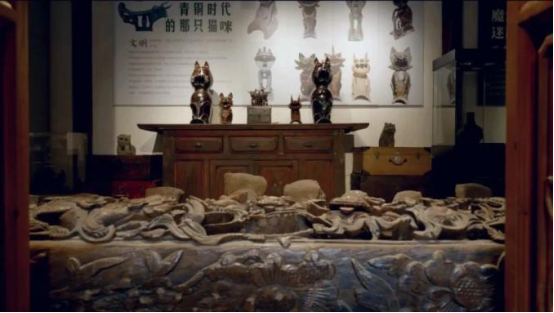
As times change, contemporary artisans are continually exploring ways to preserve and innovate the craft of wamao‑making. In 2019, Zhang Hang — a post‑90s craft successor of the municipal-level intangible cultural heritage of wamao — established the first wamao museum, “Heart‑Room Wamao,” in Kunming. In 2022, another wamao museum was founded in a traditional Yi Ke Yin (One-Seal) courtyard dwelling in Panlong District, Kunming. Since then, a growing range of cultural & creative goods have been developed, and the wamao image has gained increasing popularity.
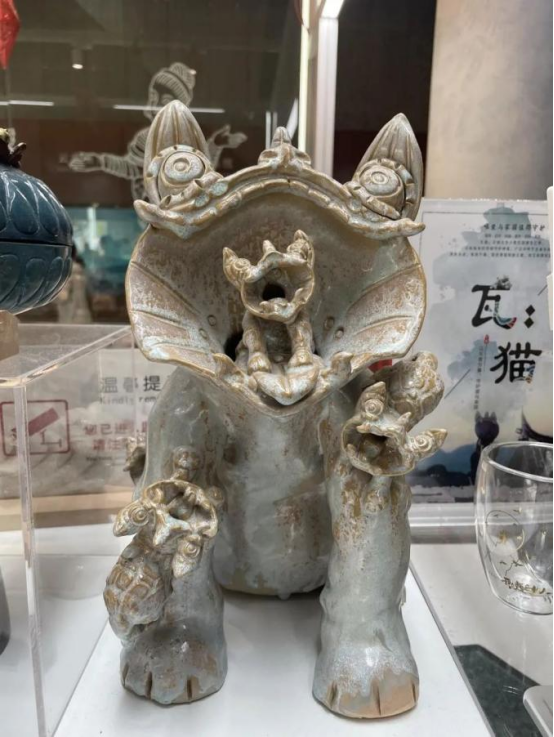
Toay, the wamao has stepped beyond Yunnan. It is no longer merely a rooftop mascot but also a sought after collectible among tourists and scholars from across the country. In its new forms, it continues to carry forward the hopes and romantic spirit unique to the people of Yunnan on this vibrant land.